Software Architecture
Overview
The code will consist of the following components:
- Data types: The underlying data model.
- File operations: Moving information into and out of the program.
- CRUD operations: Create, read, update, and delete entries from address books.
- View methods: Sort and/or filter the data.
- Interface: Graphically invoke operations, visualize views.
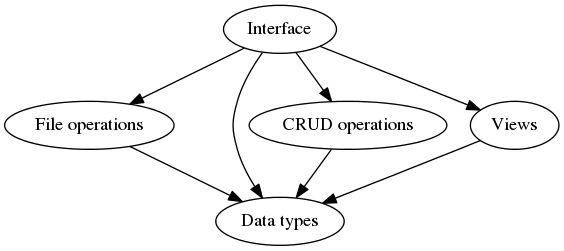
Dependencies for each component are shown below.
Data types
The application will consist of two primary data types: Books and Entries.
An Entry is a mapping between field names and values. The class also provide methods as described in later sections. There are eight fields that require a key value pair in each initial Entry:
- First name
- Last name
- Street Address
- State
- Zip code
- Phone number
Other fields may be present. Any field, including the mandatory eight, may be marked as a missing value. All missing values will be represented by null in JSON, None in Python, and some equivalent in any other format.
Non-mandatory fields may be supplied using the kwargs mechanism built into Python. Arbitrary keyword arguments should be interpreted as key value pairs to be stored in the Entry. This makes the Entry class easier to extend for new features such as user-defined fields.
Invalid input should be handled by raising an exception.
A Book is a collection of Entry objects with supporting methods described in later sections. When a method defined in Book uses the Entry class, it must handle any exceptions raised. It is valid to handle an exception by raising another exception in this context. This allows the programmers using the Book class to only need to check exceptions raised by the Book class.
File operations
The application will be capable of reading and writing data to the JSON format as well as any other user-defined formats.
Data will be stored in the user’s home directory in a folder named ”.address”. There will be a single file mapping address-book names to file names and storing other metadata associated with the address book, e.g. user-defined fields for the address book. All other files in this folder will have one to one correspondence with a single address book.
CRUD operations
An address book must support CRUD operations, i.e., create, read, update, and delete. This section will be implemented as a set of methods in the Book class. Each CRUD operation is characterized by the ability to change the state of the address book.
View methods
View methods will also be supported as methods on the Book class. These methods allow a programmer to select and organize data in a meaningful way. View methods must not alter the state of the address book. A view method must return an ordered list of entries from the address book.
As an example of a view method, consider .sort_by(field_name) a method that takes the name of a field as a parameter. By providing a field_name such as “zip_code”, the programmer can access a list of entries sorted by their zipcode.
View methods should raise exceptions when passed invalid parameters. These exceptions should be handled by the programmer any time there is a call to a view method.
Interface
No component of the application must depends on the interface. This property must be maintained in order to allow the creation of alternate interfaces.
The interface will interact with the APIs provided by all components of the application. The interface should provide the user with the ability to perform any CRUD operation. The interface should also provide the user with the ability to visualize the data in multiple ways. The view methods component is intended to provide an easy way for a programmer to access the data without needing to rewrite much of logic for rearrange the data.